I went alone to a defense hackathon in London without being ready. Here's what happened in 42 hours
No team, no contacts and no idea about defense. 42 hours later I was presenting a system that could save lives in war to founders, military people and experts.
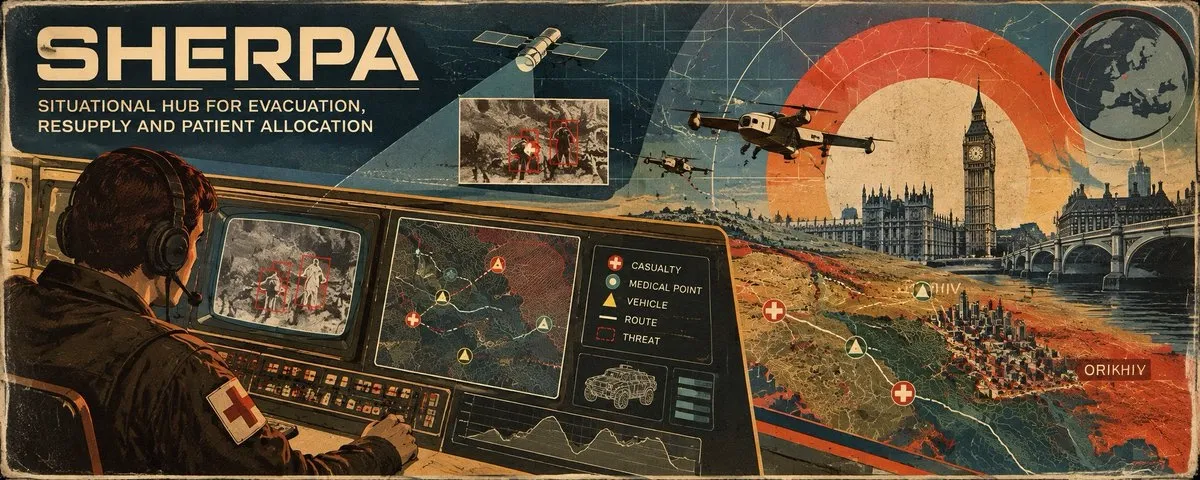
This is the story of how I went alone to a defense hackathon in London, without knowing anyone, without a team and without a clue about defense, and ended up, 42 hours later, presenting a project that could save lives in war in front of founders, military people and experts.
I’ll tell you both the experience and the technical side. The technical part has its own section, so you can read it or skip it.
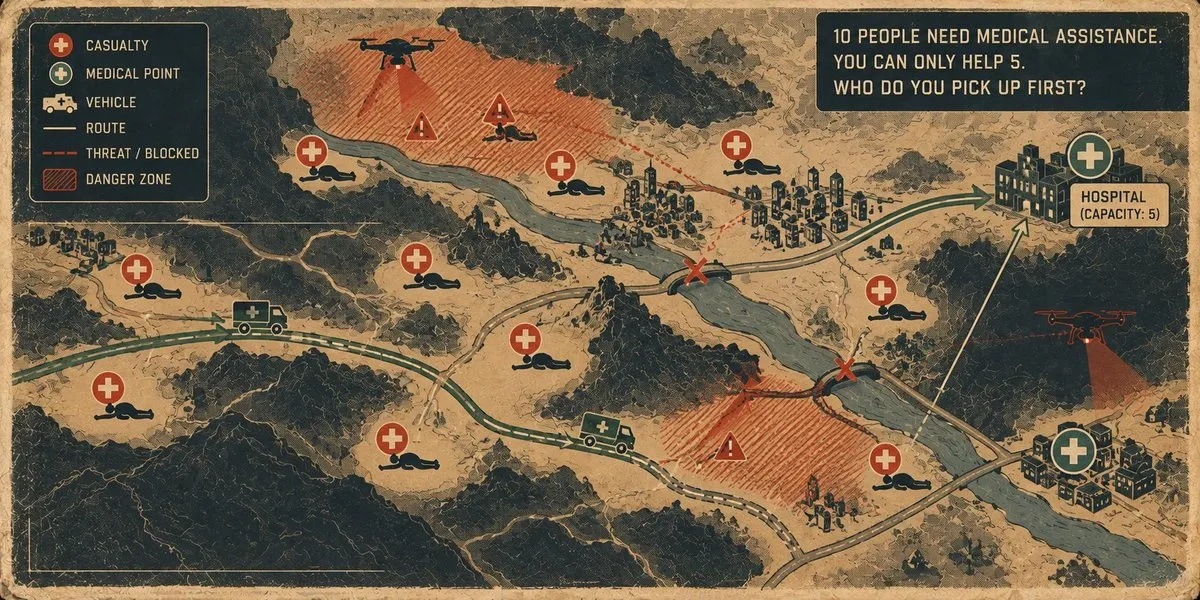
The key question is this: ten people need medical help and you can only help five. Who do you pick up first?
And at the end, the one thing I’d like you to keep, which for me was the most important part of the hackathon (and no, it isn’t a better portfolio).
1. I had no fucking idea what I was doing
About two months ago I saw there was going to be a defense hackathon in London.
It had never been a sector that especially caught my attention. Not at first, anyway. When we think about defense, we think about missiles, deaths and destruction.
And yes, all of that is part of the equation. But there was something that did catch my attention: dual-use technology.
Technology you develop for defense that can also be used in other sectors. And that’s where I come in: I’m a biomedical engineer and, along with space, health is one of my favourite sectors.
Also, I’d wanted to learn to build AI systems for extreme environments for a while.
Systems that have to keep working when conditions are bad, resources are scarce and you can’t assume everything will work the way it should.
Why? Because APIs bore me.
I wanted to build technology that had to face real problems, with real constraints and real consequences.
And, well, what environment could be more extreme than a war? It seemed like the perfect place, right?
There was one small problem, though.
The hackathon was in London.
There wasn’t one in Spain (for now, but I’ll talk about that another time).
So if I wanted to go, I had to get on a plane.
I hesitated at first, but it was free (the hackathon, not everything else, haha). And I thought: what could go wrong?
So I signed up.
When the teams started forming, I saw the profile of someone who worked at a company that helps deploy hospitals in military and emergency settings.
Bingo.
That way I could get health and defense into the same project, so I messaged him without thinking twice, and a few hours later we were a team.
Now, you’d think that with two months to go, I’d arrive at the hackathon as an expert in emergency medicine. Right?
Nope.
During those weeks I was moving house, looking for a job, starting a new chapter with a thousand things on my mind, plus a holiday in Norway.
So Thursday came, the day before the hackathon, and I still had no fucking idea about combat casualty care, defense or many of the technologies I was about to run into.
So that Thursday I left work and, while I was waiting for my flight, I put together some local HTML pages with everything I needed to learn something during the flight.
Opus 5.5 cooked me some insane HTMLs.
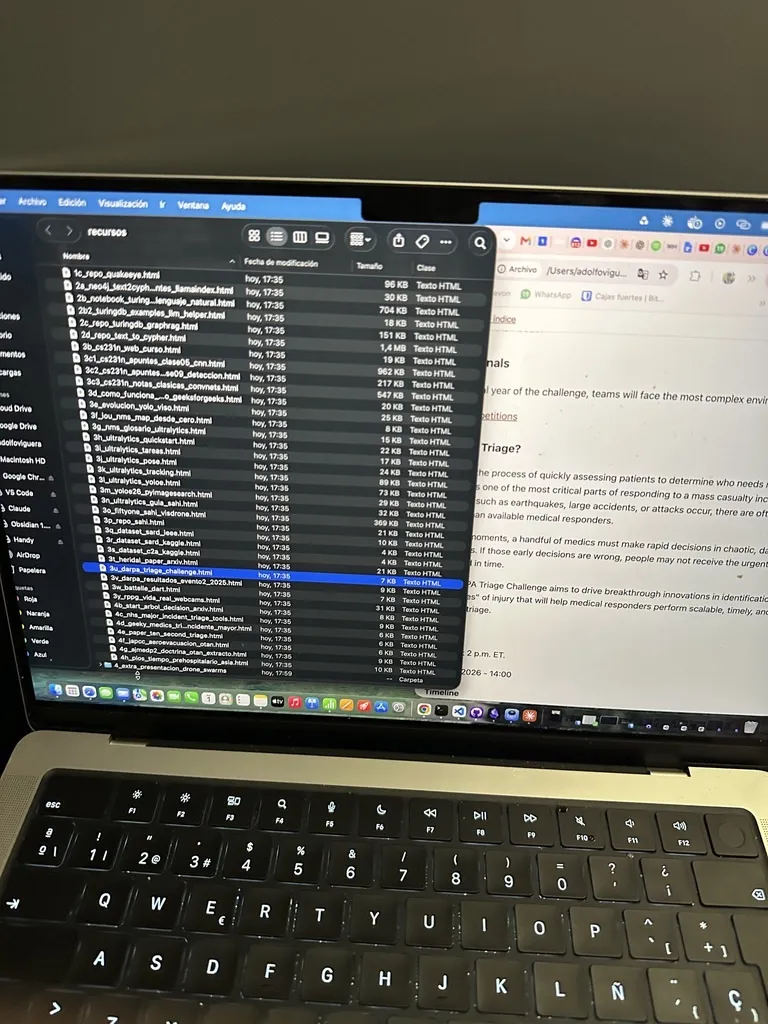
And the next day I was walking from the hotel to the hackathon, not really knowing what I’d find over the next 42 hours.
2. The problem
The event was held at the offices of a multinational.
There were people who had come from Germany, France and other places in Europe. There was even a Stanford professor with around 20 years of experience in computer vision.
The messiah of convolutions.
The father of segmentation.
The GOAT of matrices.
Okay, I’ll stop.
But yes, there I was.
Before the challenges started, my teammate and I already had a very vague idea: we wanted to do something around medical rescue in combat.
But that was it.
We still didn’t know exactly which problem we were going to solve.
Then they started presenting the challenges.
There were five, from software and data to hardware. Some involved building directly with hardware, so I ruled those out quickly. One day I’ll know robotics, but that Friday wasn’t the day.
So I went through the posters looking for one thing only:
How do we fit the medical part in here?
And then TuringDB showed up.
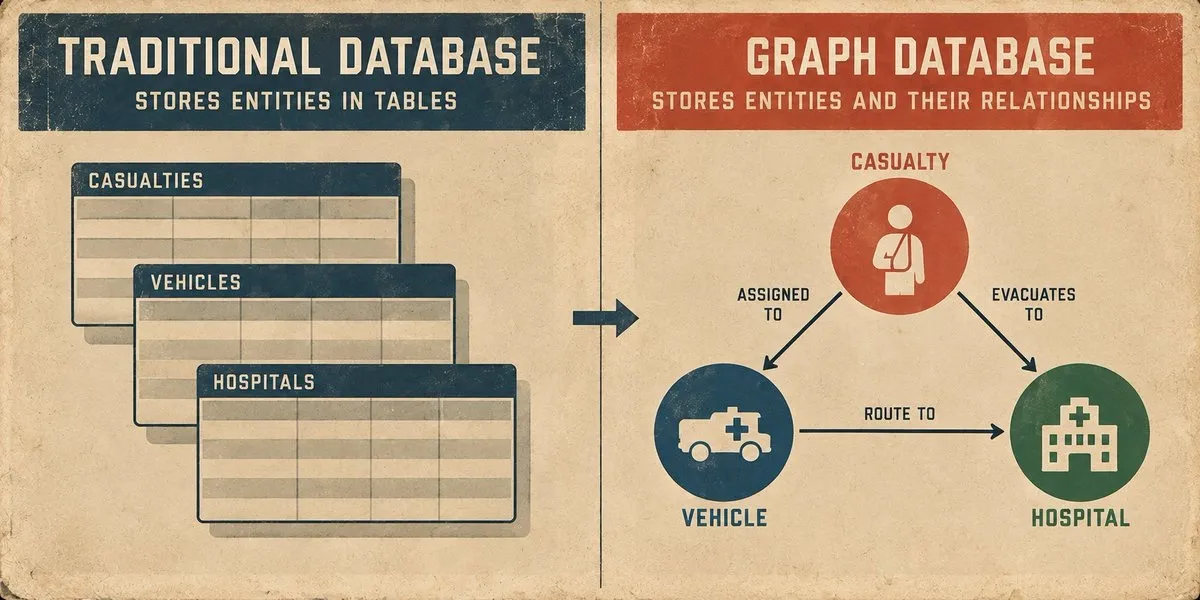
TuringDB is a graph database. For anyone who doesn’t know: sometimes the data that represents the world matters most in the relationships between things. In social networks, for example, the connections between people are what matters, so you use this kind of database.
But TuringDB is different. It’s fast as hell, ridiculously fast, and reads and writes go at the speed of Mbappé against Argentina at the 2018 World Cup in Russia.
That’s when my teammate and I looked at each other.
This was the perfect excuse.
We could use the TuringDB challenge to build our own medical rescue system.
But we were still missing the most important thing: understanding what the problem really was.
So we sat down with a mentor and started taking it apart.
The question was simple:
Ten people need medical help and you only have capacity to help five.
Who do you pick up first?
Because you can’t just send a medic to assess every casualty. The enemy knows that too: if they take out the medical staff, everyone else is left without help.
And while you try to carry out your plan, the enemy can block roads, destroy bridges or put killer drones on watch over specific routes. You can also end up with a broken-down vehicle or a medical post that’s overwhelmed.
Suddenly you have to decide who to rescue, with which vehicles, along which routes and to which medical centres, while everything around you keeps changing.
It was no longer a problem of finding the shortest path between a casualty and a hospital. It was coordinating an entire rescue operation in a changing environment.
That’s where the system we wanted to build started to take shape.
3. Before you code, draw the system
And here I applied one of the most important things of the weekend, which, deep down, is the key thing now that we all code with AI.
When you don’t know a domain, the temptation is to open the laptop and start coding.
We did the opposite.
First we tried to define the problem. Then, the system.
We spent pretty much all of Friday, from six to ten at night, doing system design and thinking about how to represent all of it.
Who were the entities? How were they related? What information did we need? What had to be able to change? What had to be recorded?
But the database still wasn’t clear. Honestly, it wasn’t easy to represent a reality so changing and so different from anything I’d seen before.
So we did something else.
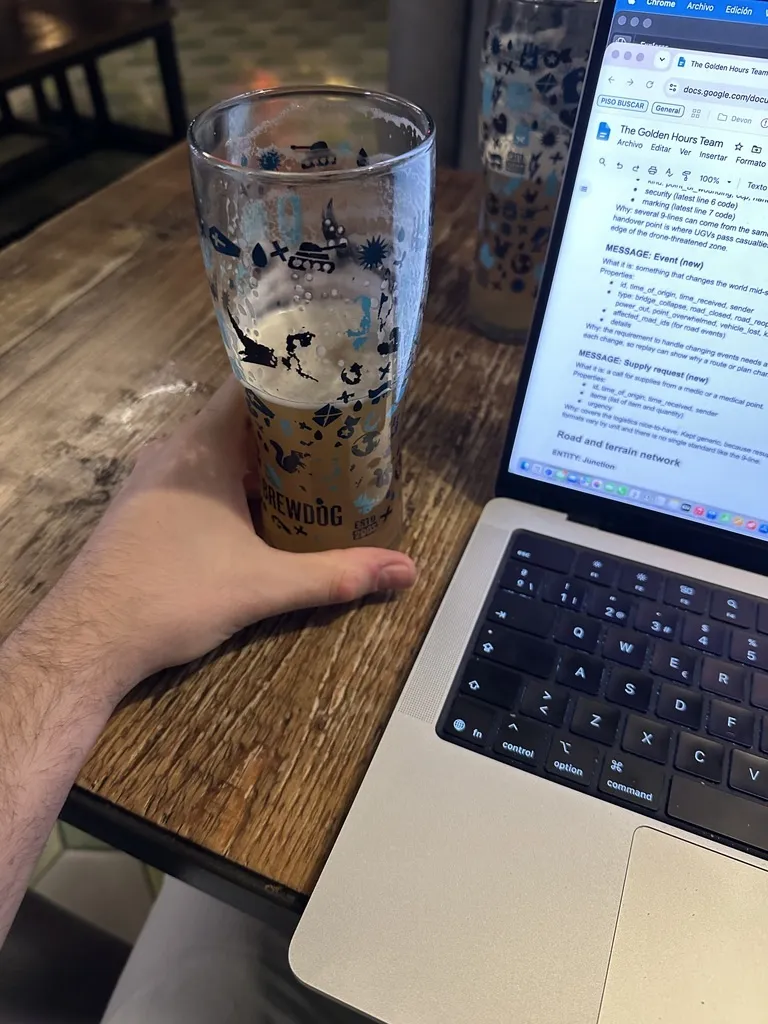
We went to a bar.
We each ordered a pint, opened our laptops, they put on AC/DC and we started designing the database.
Two guys in a bar, at night, building the data model for a battlefield medical evacuation system.
Probably one of my favourite moments of the whole hackathon.
They closed on us around 23:30, but we’d done it: the system was designed and the database was clear.
Now it was time to build.
4. SHERPA
The system ended up being called SHERPA: Situational Hub for Evacuation, Resupply and Patient Allocation. Basically, we save lives.
What follows is the technical deep dive. This is how SHERPA works (if you’re not interested, skip to section 5).
Step 1. Like building a house, we started with the ground. We took the real roads of the area from OpenStreetMap (an open-source road dataset) and put them into the graph, so that every junction was a node and every stretch of road a connection carrying the time it takes to drive it. That way we could compute the shortest path with Dijkstra’s algorithm.
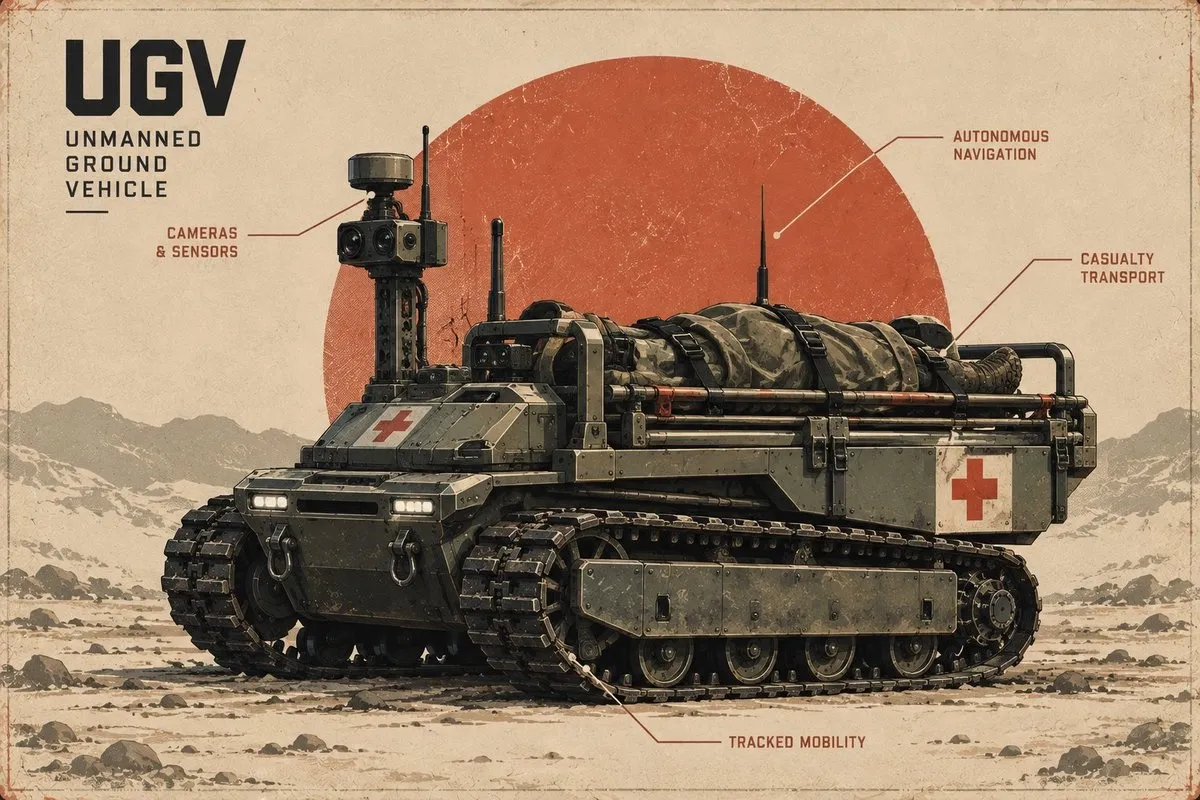
On top of that ground we placed everything else: first the wounded, called casualties. Then the vehicles, which included ambulances and UGVs (Unmanned Ground Vehicles, or in plain English: ground vehicles with nobody inside). And the medical points, from nearby casualty collection and stabilisation points to field hospitals further away.
Step 2. How do we find the wounded? Drones detected people on the ground with YOLO, a computer vision model that draws a box around each person and gives a confidence between 0 and 1. With the drone’s position, altitude and camera, we turned each box into real-world coordinates.
As a second source we had an app carried by the soldiers themselves, which sent their position and the data of each casualty. Two different sources pointing to the same place: that way the system knew better where each person was and how much it could trust that data.
In the future, this app could be a local LLM that asks you questions to gather the key information (you, if you’re conscious, or your fellow soldier if you’re not). It could even close the clinical decision loop when there’s no internet.
Step 3. Who decides who gets taken out first? SHERPA’s user was the medical team, far from the front and safe from attack. And the goal was simple: don’t bring the doctor to the clinical information, bring the clinical information to the doctor.
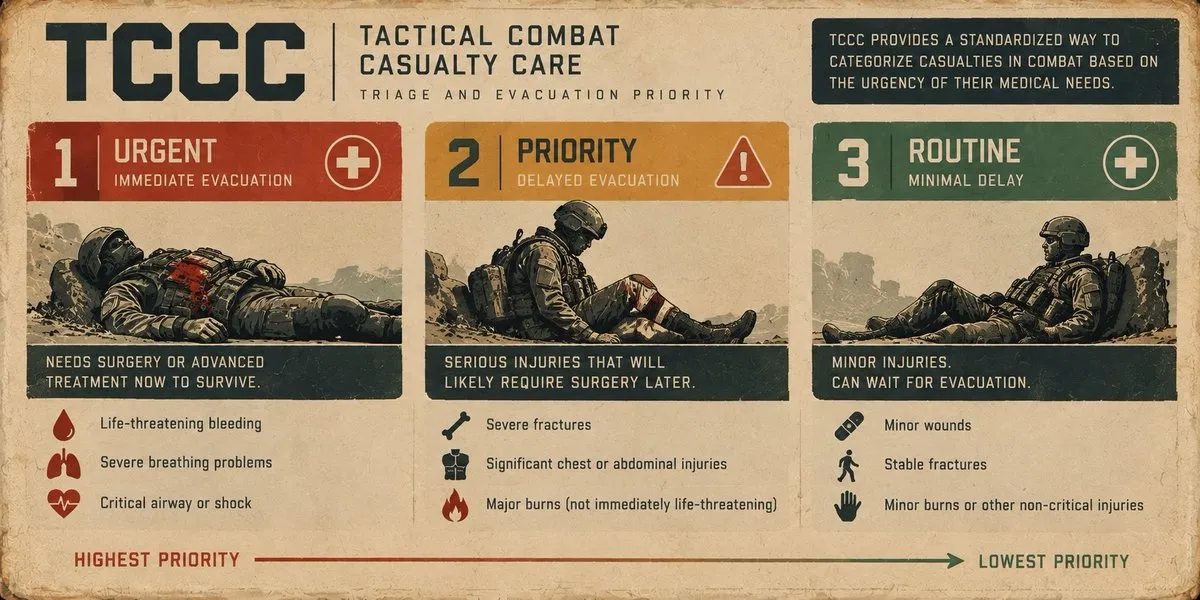
For that, each casualty came in with a first classification made by a fixed rule system based on TCCC (Tactical Combat Casualty Care), the reference guidelines for treating casualties in combat. TCCC ranks casualties by evacuation priority in three levels:
- urgent (needs surgery or advanced treatment right now to survive)
- priority (serious injuries that will need surgery later)
- routine (minor injuries)
But that classification was only the starting point. The doctor reviewed every case and set the final priority. For us this was non-negotiable: the AI didn’t decide clinical priority. From there, the system took care of organising the information, showing the consequences of each decision and helping coordinate the evacuation.
Step 4. From decision to mission. With those decisions, SHERPA generated missions. And a mission wasn’t simply “go from A to B”.
It was a specific number of ambulances and UGVs, each with a given capacity, picking up particular casualties in a certain order and following the shortest available route. And taking them to the next link in the medical chain: from the point of injury to a stabilisation point, then to a Role 1 (the first medical post, where triage, resuscitation and stabilisation happen, but no surgery), then to a Role 2 (which has an operating theatre to save life and limb) and, finally, to a field hospital.
In the graph, each mission was its own node, connected to its vehicle, its casualties, its destination and every junction on its route. That’s what made the next step possible.
Step 5. What if something changes? This is where it got interesting. A road got cut, a vehicle stopped being available or a medical point got overwhelmed, and a single Cypher query (TuringDB’s “SQL”) walked the graph in one go (road → junctions → missions → casualties) and told you in milliseconds which missions had broken and which casualties were no longer going to make it in time. To test it we built a simulation that kept releasing events and changing conditions on the fly.
Step 6. Keeping the history. And here TuringDB had a particularly interesting advantage: we could version the graph, the same way Git versions code. Every change was a commit that couldn’t be modified. Instead of deleting the previous state and replacing it with a new one, every change was kept.
That let us open a branch (in TuringDB they’re called “changes”), try an alternative plan and compare it with the current one before deciding, and also go back to any commit to see exactly what we knew when each decision was made. SHERPA stopped being just a planning tool and also became a way to understand how we’d got to each decision.
Step 7. The cherry on top: talking to the system. A doctor coordinating an evacuation has no time to write Cypher queries. So we added voice: the operator asked the question out loud (“which urgent casualties still have no vehicle?”) and Parakeet, NVIDIA’s speech recognition model, turned it into text. Then an embedding model (I don’t remember which one, but for defense reasons it wasn’t Chinese, haha) turned that question into a vector and compared it with the queries we had prepared, picking the closest one. That query ran against the graph and the answer showed up on the map.
The operator saw all of this on an interactive map. You can see it working in this one-minute video: SHERPA demo.
5. Saturday: the calm before the storm
Saturday was much less cinematic.
We built pretty much everything I described above: data integration, routing, simulation, drone detection, the interface and the mission logic.
And it was less complicated than it could have been, because on Friday we’d spent the time modelling the data and laying the foundations. With that done, each of us could work on our own features without stepping on the others.
When the system is well designed, coding stops being a string of improvised decisions.
You already know what you want to build, what each piece represents and how it relates to the others.
And then you can spend the time executing.
Of course, not everything went perfectly.
But little by little, what on Friday afternoon was a pile of boxes drawn on a crappy Miro board started to look like a real system.
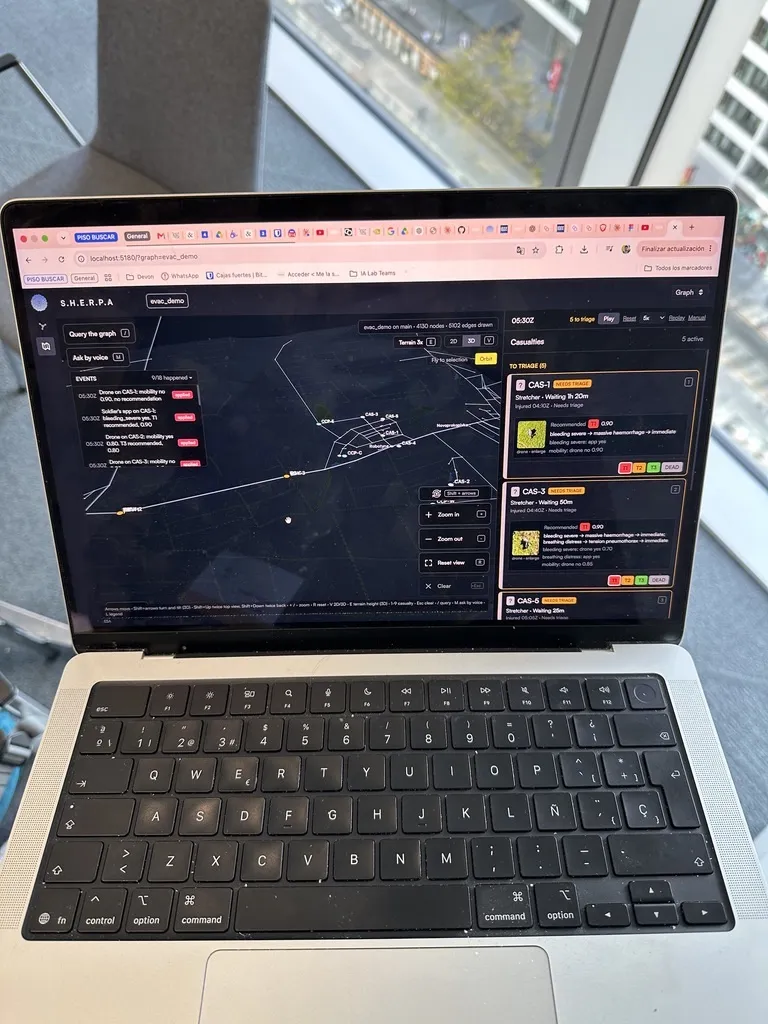
CAS-X means casualty number X: each one is a wounded person.
And then… another problem appeared.
The pitch.
6. I hadn’t come all the way to London to stay quiet
We’d been told we had to present in front of everyone.
At first I thought about not doing it. For a moment, that thought crossed my mind.
In front of us there were investors, defense people, companies, technical experts and people who had been working in that world much longer than us.
But I quickly corrected myself.
Had I come all the way to another country for this? To watch it from the seats?
No way, man.
I’d done pitches before and making content had given me some ease, so I had to use it to shine.
So I’d decided: I was going to pitch in front of everyone.
At the end of the day I went back to the hotel and went to sleep with the pitch in my head. The next morning, I was going on stage.
Now, you’d think I just presented, answered a few questions and that was it, right?
No. I had an ancient move in my pocket. A move worthy of the greatest LinkedIn performer in history. The ultimate larper. The greatest farmer of connection requests with no note ever.
At the end of the presentation we left up a QR code with the LinkedIn of each of the four team members during the questions. Four QR codes so the whole room could scan them in the meantime.
Sorry. Back to the story.
7. Someone brought a plane
While I watched the other teams’ presentations, I started to think winning was going to be hard.
There were people who had been working on drones for months.
Someone else had built a foundation model in spatial AI.
And someone had brought, literally, a miniature plane.
We had started about 42 hours earlier, knowing practically nothing about that domain.
And that felt a bit unfair to me. The point of a hackathon is that they give you the challenges on the spot and everyone starts from zero.
Although, to be fair, it makes sense. It’s a defense hackathon, and nobody builds a drone in a weekend.
But hey, it would have been nice to know beforehand.
We didn’t win, but we got an honourable mention. Also, the company behind the challenge shared our project on LinkedIn and many mentors told us ours was their favourite.
The underdogs, ladies and gentlemen.
What they valued was that we were tackling a real problem that’s underserved in the defense sector, and from a different angle.
But funnily enough, the result didn’t matter much to me.
Because two days earlier I knew almost nothing about combat medicine, defense or detecting moving objects.
And now I could explain the problem, defend an architecture, show a working system and discuss with experts how to improve it.
I’d arrived alone in London to do something I didn’t feel ready for.
And it worked.
Not perfectly. But it worked.
And I met some really top people, honestly. That’s always great.
8. What I’m really taking away
This last month has been one of the most hectic of my life.
I’ve moved city, started a new job and started living alone, far from the family and friends I’ve known for as long as I can remember.
So when it was time to get on a plane to go to a defense hackathon in another country, something happened that I didn’t expect: it was much easier than I thought.
Even though it was the first time I’d gone alone to a hackathon in another country, it felt like I’d done it before.
And I think it makes sense.
The first time you expose yourself to something new, it’s really hard.
But every jump makes the next one a little smaller.
We often wait to feel ready before doing something. Me too.
But if I’d waited to know about defense, combat medicine, graphs, simulation and computer vision before signing up, I’d never have gone.
First I said yes.
Then I found out what I didn’t know.
And finally I learned enough to build something useful.
That’s why I’m glad I got on that plane.
Even though we didn’t win.
Even though on Thursday I had no fucking idea what I was going to do and was revising computer vision on the plane.
Because some of the most interesting things you can build start exactly like this: with no idea how you’re going to pull it off.
So if you don’t feel ready, that’s the sign to do it.
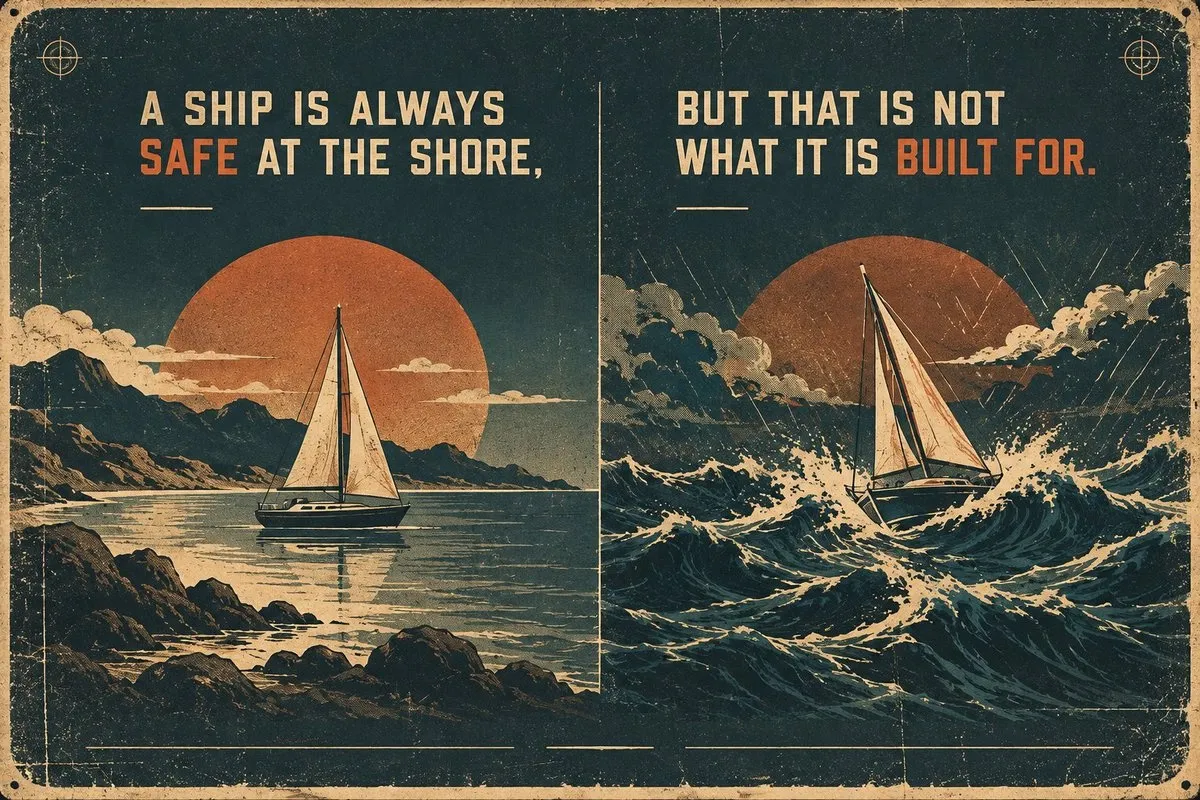
There’s a line I saw recently that I saved because it really resonated with me, so I’ll end with it:
“A ship in harbour is safe, but that is not what ships are built for.”
First published on X.